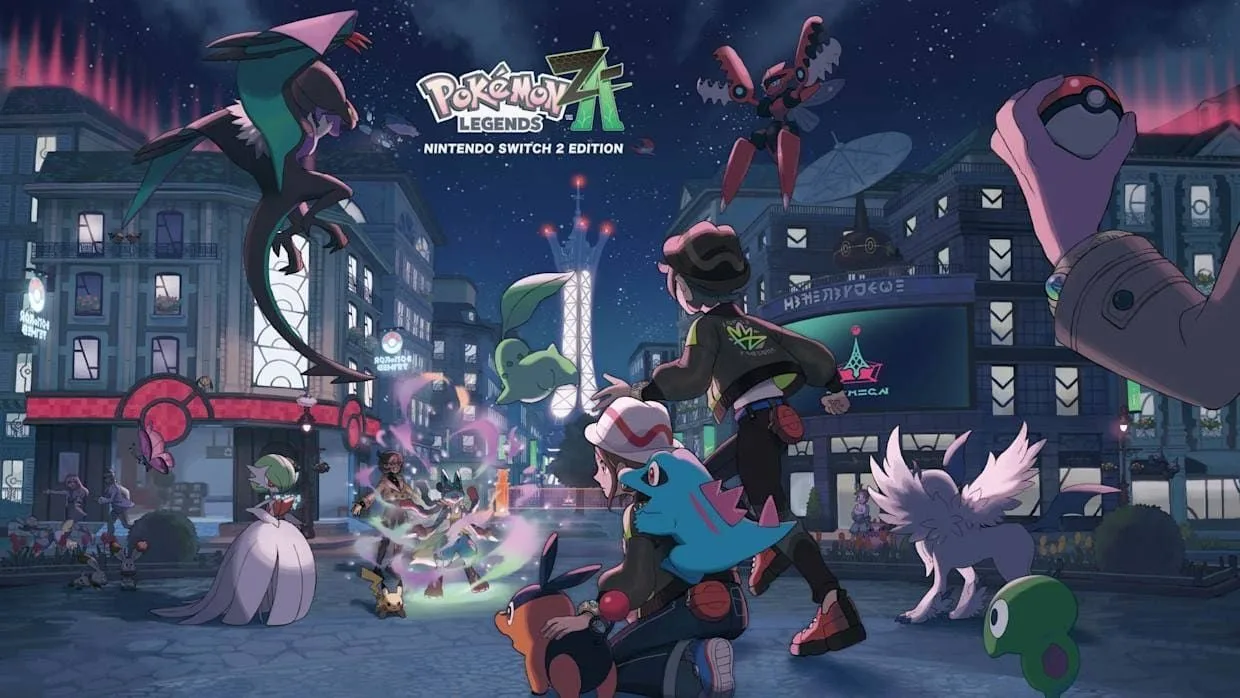
The short version
Game Freak's follow-up to Pokémon Legends: Arceus moves the action-RPG structure into a single, real-time-battling city rather than a series of wild zones. It landed at 81 on Metacritic — the second-best mainline Pokémon score of the Switch era, behind only Legends: Arceus.
What works
- Real-time battles that reward positioning rather than menu selection alone
- Lumiose City visibly rebuilds and changes shape as the story progresses
- A fast, generous catching loop that respects a shorter play session
- The most structurally ambitious mainline Pokémon game in years
What doesn't
- Frame rate reportedly dips at night and in crowded city districts
- The story doesn't fully match the ambition of the city-rebuilding concept
- A single-city setting will feel small next to prior open-world entries
- Some returning systems feel undercooked next to the real-time battle rework
What it is
Pokémon Legends: Z-A trades the wild-zone structure of Pokémon Legends: Arceus for a single setting: Lumiose City, competing in the Z-A Royale tournament while the city itself is rebuilt around the player over the course of the story. It's the first mainline Pokémon game to run battles in real time rather than a turn-based menu screen, with players and Pokémon both moving on the field mid-fight.
Developed by Game Freak, it released on the original Switch and, per Nintendo's own Switch 2 Edition materials, with an enhanced Switch 2 version at launch.
Real-time battles change the read
The shift to real-time battles was the most-discussed change in critical coverage — positioning, move timing and area-of-effect awareness now matter in a way the turn-based mainline games never asked for, and reviewers were broadly positive that the change adds a genuinely new skill layer rather than just cosmetic motion.
It landed at 81 on Metacritic, per aggregated critic reviews — the second-highest mainline Pokémon score of the Switch era, trailing only Pokémon Legends: Arceus.
One city, rebuilt block by block
Rather than a traditional region, the entire game is set inside Lumiose City, which visibly changes shape — new districts, altered skylines — as the Z-A Royale story progresses. Critics called this the boldest structural swing the series has made in roughly a decade, while noting the story beats driving those changes don't always carry the same weight as the visual transformation itself.
Performance: Switch vs. Switch 2 Edition
Technical outlets reported frame rate dips on the original Switch in Lumiose's busier districts and at night; the Switch 2 Edition was reported to hold a more stable frame rate at a higher resolution.
| Mode | Resolution | Frame rate | Load |
|---|---|---|---|
| Switch 2 Edition | 1080p docked-class | 30fps, more stable | — |
| Switch (original) | 720p-1080p | 30fps, reported dips at night | — |
Accessibility and comfort
- Adjustable text size and battle-camera options
- Auto-battle assist options for younger or newer players
- Motion and camera-shake reduction
- No colorblind-specific mode as of this writing
Is it worth it
$59.99 (Switch) or $69.99 (Switch 2 Edition) for the most structurally different mainline Pokémon game in years, backed by the series' second-best Switch-era critical reception. Worth it for players who want the real-time battle system; less essential for those attached to the traditional wild-zone structure of Legends: Arceus.
If you liked this, play
How we reviewed it
This review draws on Game Freak's and Nintendo's own release materials, aggregated critic scores, and public player and technical-outlet reporting since the October 2025 launch — not first-party lab testing by this desk.